
Compliance & Audits

Environmental compliance is about more than simply meeting approval conditions. Effective compliance management requires an understanding of site activities, environmental risks, legislative requirements and the practical realities of operating a project or facility.


Dynamic Environmental Services provides environmental compliance and auditing services for mining, waste, landfill, renewable energy, gas and infrastructure projects throughout Australia. We help clients understand their obligations, identify compliance risks and develop practical solutions that support ongoing compliance and project success.


Our compliance and auditing services include:

  • Environmental compliance inspections
  • Internal compliance audits
  • Independent third-party audits
  • Environmental Authority compliance audits
  • Development Approval compliance audits
  • Contractor environmental audits
  • Environmental management system audits
  • ISO 14001, ISO 9001 and ISO 45001 internal audits
  • Compliance database development and review
  • Compliance obligation registers
  • Gap analysis and compliance reviews
  • Corrective action development and tracking
  • Regulatory compliance advice
  • Regulatory inspection preparation and support
  • Environmental Authority interpretation and advice


Our team has extensive experience auditing compliance against a wide range of approvals, licences, permits, management plans and regulatory requirements.


This includes Environmental Authorities, Development Approvals, Operational Works approvals, Environmental Management Plans, Erosion and Sediment Control Plans, Stormwater Management Plans, Emergency Response Procedures, EPBC approvals, landholder agreements and other project-specific obligations.


Unlike many auditors, our personnel have worked directly on construction, operational and industrial sites before becoming consultants. This practical experience allows us to understand the realities of site operations and distinguish between genuine compliance risks and issues that can be resolved through practical management actions.


We take a balanced and evidence-based approach to auditing. Before identifying a non-compliance, we seek to understand the circumstances, intent of the requirement and available supporting evidence. Where improvements are required, we work collaboratively with clients to develop practical and proportionate solutions that consider operational requirements, site constraints, available resources and long-term management implications.


Our team also assists clients to navigate complex compliance situations, including regulator inspections, Environmental Enforcement Orders (EEOs), Pre-Enforcement Letters, Penalty Infringement Notices (PINs), Warning Letters and other regulatory compliance matters. We can help interpret requirements, review available evidence, engage with regulators and develop practical, defensible pathways to achieve and maintain compliance.


Our audits are designed to be useful, not simply compliant. We provide clear, concise reporting and practical recommendations, ensuring actions are easy to understand, prioritise and implement. Our goal is to help clients improve environmental performance, reduce regulatory risk and maintain compliance without creating unnecessary administrative burden, overcomplicated management systems or excessive compliance costs.


Whether you require an independent third-party audit, support preparing for a regulator inspection, assistance responding to compliance action, or help developing a compliance management framework, we provide practical, defensible and outcome-focused advice tailored to your project and operations.
How can we help?

Related Projects and Articles
By Lisel Dingley June 12, 2026
Large water infrastructure projects often operate under complex approval frameworks involving multiple operators, contractors, monitoring programs and regulatory obligations. Demonstrating compliance requires more than simply collecting monitoring data; it requires robust systems, clear responsibilities and effective governance across all parties involved. Dynamic Environmental Services was engaged to undertake an independent compliance audit of a major regional scheme operating under an End of Waste Approval framework. The project involved a comprehensive review of approval conditions, operational records, monitoring data, annual reporting, management systems and field operations over a five-year audit period. A key challenge was the complexity of the operational and contractual arrangements supporting the scheme. Compliance obligations were shared across multiple organisations, requiring a detailed review of monitoring programs, reporting pathways, contractor responsibilities, operational procedures and evidence used to demonstrate compliance with approval conditions. Our services included: Independent third-party compliance auditing Review of approval conditions and regulatory obligations Review of monitoring data and compliance records Assessment of operational and management systems Site inspections and field verification Review of annual reporting and compliance documentation Identification of compliance risks and gaps Development of corrective actions and opportunities for improvement Review of contractor and governance arrangements Strategic advice regarding compliance management and reporting Rather than focusing solely on identifying non-compliances, our approach sought to understand the broader systems supporting compliance and identify opportunities to improve efficiency, governance and regulatory defensibility. This included reviewing monitoring programs, reporting processes, contractor oversight arrangements, data management systems and operational procedures. The audit identified a high level of overall compliance while also highlighting opportunities to strengthen monitoring, reporting and governance processes. Recommendations were developed to improve accountability, streamline compliance management and provide greater confidence that approval obligations could continue to be effectively met into the future. The project required balancing regulatory requirements, operational realities and practical implementation considerations. Particular attention was given to ensuring recommendations were achievable, proportionate and capable of being integrated into existing operational systems. Outcomes Independent assessment of compliance against approval conditions Comprehensive review of five years of operational records and monitoring data Identification of compliance risks and opportunities for improvement Practical corrective actions developed to address identified issues Improved understanding of compliance obligations and responsibilities Enhanced governance and contractor oversight recommendations Improved regulatory defensibility and audit readiness Increased confidence in ongoing compliance management  This project demonstrates Dynamic Environmental Services' capability to undertake detailed environmental compliance audits across complex infrastructure and operational projects. By combining regulatory knowledge with practical operational experience, we help clients understand their compliance position, reduce regulatory risk and develop systems that support long-term environmental performance.
By Lisel Dingley June 11, 2026
Large industrial sites often inherit decades of historical activities, leaving a legacy of poorly understood contaminated land issues. Over time, these sites can accumulate multiple contamination concerns, varying levels of historical investigation, changing regulatory requirements and uncertainty regarding actual environmental and human health risks. Dynamic Environmental Services was engaged to assist a major industrial operation with the assessment and management of a large portfolio of legacy contaminated land sites. The project involved reviewing, investigating and prioritising numerous contamination issues across a large operational footprint, including contaminants such as asbestos, heavy metals and agricultural chemicals. A key challenge was developing a consistent and defensible approach to understanding risk, prioritising actions and ensuring resources were directed toward areas presenting the greatest environmental, regulatory and community risk. Our services included: Site inspections and historical information review Development of contamination investigation strategies Preparation of sampling and analysis plans Source and soil sampling programs Data interpretation and comparison against relevant guidelines and investigation criteria Development of site-specific investigation and assessment criteria Coordination of specialist environmental and human health risk assessments Regulatory notifications and stakeholder engagement Design and implementation of interim risk management measures Development of remediation and management strategies Management of remediation contractors and field activities Preparation of ongoing management plans Development of streamlined internal processes and decision-making frameworks Rather than treating each issue as a standalone project, our approach focused on developing a structured and repeatable framework for assessing contamination risks across the entire operation. This allowed investigation efforts, risk assessments and remediation activities to be prioritised based on actual risk, while improving consistency, efficiency and regulatory defensibility. The project required balancing environmental protection, human health considerations, operational requirements, regulatory expectations and budget constraints. Particular attention was given to potential impacts on surrounding communities and environmentally sensitive areas, ensuring risk management decisions were supported by robust technical evidence. Outcomes Improved understanding of legacy contamination risks across the operation Development of a consistent and defensible contaminated land assessment framework More effective prioritisation of investigation and remediation activities Reduced regulatory risk and improved compliance outcomes Practical and cost-effective risk management strategies implemented Protection of environmental values and community health Improved internal capability to manage future contaminated land issues
By Lisel Dingley March 29, 2026
We regularly see sites assume that because they hold approval for an ERA, they can undertake anything that falls within that ERA. That’s not how Environmental Authorities work. An EA does not approve the full scope of what an ERA could include. It approves what you applied for — including the way the activity is undertaken, the infrastructure used, the controls you committed to and the scale and intensity you described. Sometimes, there are some obvious limitations set by your EA per ERA. For example, you may hold ERA 54 Mechanical Waste Processing, Threshold 2 (general waste), therefore, if you want to take regulated waste, you know that you aren't licenced to do so, as it is Threshold 3 & 4. It's the more subtle changes where things can come unstuck, particularly in the waste management ERA space. What Your EA Actually Covers When your EA is granted, it is based on a specific proposal. That proposal includes: The activity itself Where it will occur What materials or wastes are involved How it will be undertaken What controls are in place to manage environmental risk That combination forms the risk profile that was assessed and approved. It is not a blanket approval for all variations of that activity/ERA. Where Sites Get Caught Out Most non-compliances in this space are not deliberate. They come from operational changes that seem minor at the time: Moving an activity to a more convenient location Scaling up volumes Changing inputs slightly Adjusting how something is managed day-to-day Individually, these can seem insignificant. But from a regulatory perspective, they can fundamentally change the risk to environmental values — which means they fall outside what was originally approved. Example 1 – Crushing Concrete under ERA 54 You are approved to undertake crushing concrete under ERA 54. What was approved: Crushing within an enclosed building Dust suppression sprays on the machine Settled dust wet cleaned within bunded area, and vac truck removed offsite to be disposed at facility that is licenced to accept it You now want to undertake crushing outdoors. It’s still crushing — so it feels like it should be fine. But the risk profile is no longer the same: Dust is no longer contained and can travel offsite Fine material can be mobilised into stormwater Noise is no longer attenuated by the building (for offsite sensitive receptors/neighbours) Wind becomes a factor The original approval was based on a controlled system. Moving outdoors changes how emissions behave and where they end up. Example 2 – Wastewater Reprocessing under ERA 55 You are approved to receive and reprocess wastewater in ponds. What was approved: A purpose-built pond with engineering design Construction Quality Assurance (CQA) completed Leak detection system installed Groundwater monitoring bores in place Defined and assessed allowable inputs You now want to construct another pond, or accept a slightly different input. Again, this appears similar. But, because you think you are already approved for this activity, you aren't putting together an EA application which steps through all the requirements, and therefore, some aspects get missed: If the new pond is missing any of those design or verification elements, seepage risk increases Without monitoring or leak detection, early warning systems are lost Different inputs may behave differently in storage or treatment (for example, odour risk) The original assessment of contaminants and volumes may no longer apply Even if the pond looks the same, the certainty of performance and level of risk is not the same. Example 3 – Other Activities under ERA 55 You are the same site as Example 2, already approved under ERA 55 to receive and reprocess wastewater in ponds. You now want to treat contaminated soils using stabilisation (e.g. lime dosing). It’s still ERA 55 — so it feels like you should be covered. But let's think about what was approved: Treatment of liquid waste in lined ponds Risks primarily related to odour, pond failure, seepage and groundwater What changes: Dust generation from handling soils Airborne contaminants and exposure pathway To be undertaken in an unlined, unbunded area Stormwater contamination from open treatment areas Land contamination risks Potential for offsite reuse (if uncontrolled, contamination of other sites) Same ERA — completely different risk. The original EA for wastewater ponds does not consider these impacts, so the new activity has not been approved. Why “Almost the Same” Isn’t the Same A key point that is often missed is this: Environmental risk is driven by more than just the activity itself. It is driven by: How emissions are generated How they are controlled The pathways they can travel The receptors they can reach Small changes to any of these can significantly change the outcome. Two activities that look identical operationally can have very different impacts once you consider odour, dust, surface water, noise, or groundwater pathways. When Do You Need an EA Amendment? As a general rule: Assume an EA Amendment is required. Request a pre-lodgement meeting, be clear about the change you are thinking of, and take guidance from the assessing officers. This is not a space for “we’ll just make the change and see how it goes”. Why It Matters Operating outside the scope of your EA is not just a paperwork issue. It can result in: Non-compliance with conditions Environmental harm or nuisance Regulatory action Be issued a stop works notice, essentially cutting off your source of income Costly and time-consuming remediation or retrospective approvals We often see sites end up in a far more difficult position trying to justify a change after the fact, rather than assessing it properly upfront. In Closing Your EA is not an approval for everything that falls under the ERA listed on your licence. It is approval for what you applied for — a specific activity, undertaken in a specific way, with specific controls. If those things change, your approval may no longer apply. That’s why the detail in your original EA application — and any amendments — matters. What you describe is what gets assessed, and ultimately, is what you are approved to do. If your operations are evolving, don’t assume you’re covered. Stop, assess the risk, and confirm whether an amendment is required. Give us a call to discuss your waste-related activities — whether it’s an original EA application or an amendment. Last updated 29 March 2026. This information is general in nature, may not be current, and may not be applicable to your specific circumstances. It should not be used as a substitute for site-specific professional advice.
By Lisel Dingley March 27, 2026
When is it a resource? When is it a waste? And what do you actually need to do? 
By Lisel Dingley November 19, 2024
Hypothetical Situation: A site’s Environmental Authority lists a number of groundwater bores, and states that they must be monitored for certain parameters 6 monthly. The EA has another condition which states that a groundwater review must be undertaken every 3 years by an appropriately experienced person (hydrogeologist). The site diligently samples the groundwater bores, and collates the field and laboratory results into a spreadsheet. However, those results are not reviewed when they are received… because the EA says that a groundwater review must be undertaken every 3 years, with no other specific review obligations. Given groundwater monitoring is intended as a warning system for contamination, is only reviewing the groundwater results every 3 years adequate to meet the General Environmental Duty of the Environmental Protection Act? Or a general EA condition such as the requirement to take all reasonable and practicable measure to prevent or minimise the likelihood of environmental harm being caused by the activities? When a dam containing hazardous waste is found to be leaking (found upon visual inspection), and subsequently the previous two years of groundwater data are reviewed and found to indicate this has been occurring prior to the visible leak being detected, it is likely this will not be looked upon favourably in a prosecution. “But it wasn’t time for our 3 yearly review!” is unlikely to be acceptable to the Regulator. Perhaps the EA has another condition which states that deterioration of groundwater quality must be reported to the Regulator within 14 days of receipt of the results. If data is only reviewed every 3 years, how is this condition being met? Perhaps the EA has a condition that requires the development and implementation of a Groundwater Monitoring Plan. It is suggested an adequate Groundwater Monitoring Plan should include guidance on interpretation of results, not just what, when and where to monitor. In our opinion, a Groundwater Monitoring Plan without interpretation guidance is defective and non-compliant with the intent of the condition. And if it does have guidance, is this clear enough to be accurately and swiftly executed by site personnel? We see many shortcomings in groundwater monitoring. Some of the most common and most significant include: · Data that clearly demonstrates potential environmental harm, which has not been noticed or investigated. There are some really easy ones in this space – your groundwater should not have PFAS in it! If it does, you either have identified contamination of the aquifer or contamination of your samples by your sampling methodology or the laboratory. Regardless, this should be promptly investigated. · Sites not being aware which of their bores is a leak detection bore and which are aquifer monitoring bores. One should be dry and the second should not be dry, and if this is not the case, this needs investigating. · Sites not having modelled groundwater flow direction to determine what is an upgradient (background) monitoring bore, and what is downgradient (identification) monitoring bore, and therefore not being able to interpret results adequately. · Not monitoring water quality in ponds that have the potential to leak, and therefore being unaware of the potential contaminants that would indicate seepage into the aquifer from the pond. Groundwater monitoring can be a highly effective detection system of potential environmental harm, but only if it is undertaken well, by persons with a comprehensive understanding of monitoring well construction, groundwater and contaminants, and with an adequate system of bores in place. Last updated 19 November 2024. This information is general in nature, may not be current, and may not be applicable to your specific circumstances. It should not be used as a substitute for site-specific professional advice.
By Lisel Dingley September 17, 2024
Definitely not! We have put together a quick list of aspects which might mean you cannot clear your Category X Vegetation. If the clearing may impact Matters of National Environmental Significance (MNES) under the Commonwealth EPBC Act, noting Category X (a State-based classification) does not remove the need for federal referral/approval, particularly where vegetation has regrown for 15+ years or provides habitat for threatened species. If Protected Plant Trigger Mapping exists across the area you intend to clear, and you have not had a flora survey undertaken and/or have a protected plant clearing permit. This can also apply if protected plants exist without trigger mapping. If the clearing is through a mapped waterway for waterway barrier works and may constitute a temporary (or permanent) barrier, and you haven't confirmed compliance with the Accepted Development Requirements for waterway barrier works, including submitting your pre-works notification. If the clearing is through a watercourse, and does not meet the exemption requirements of a Riverine Protection Permit, and you do not hold a Riverine Protection Permit. If you are not within your lot boundary, for example, when your lot or your adjoining lots are intersected by a mapped easement such as for a river or road, or you want to clear in the road easement in front of your property. If your clearing will (or may) disturb an animal breeding place and you do not have a Species Management Program in place. If your clearing will include ground disturbance and you have not met your Cultural Heritage Duty of Care requirements. If the vegetation is mapped as protected under a local government planning scheme, and you do not have an approved clearing permit from the local government. We often work with landholders who have unintentionally undertaken unpermitted clearing, and are subject to enforcement action by the Regulator. Remedying this is costly and time consuming. This is not a space for ‘act now, and ask for forgiveness later’. You may find yourself planting back out the trees you cleared plus 50% more, and being committed to ensuring their survival for the next 15 years. Last updated 8 April 2026. This information is general in nature, may not be current, and may not be applicable to your specific circumstances. It should not be used as a substitute for site-specific professional advice.
By Lisel Dingley August 27, 2024
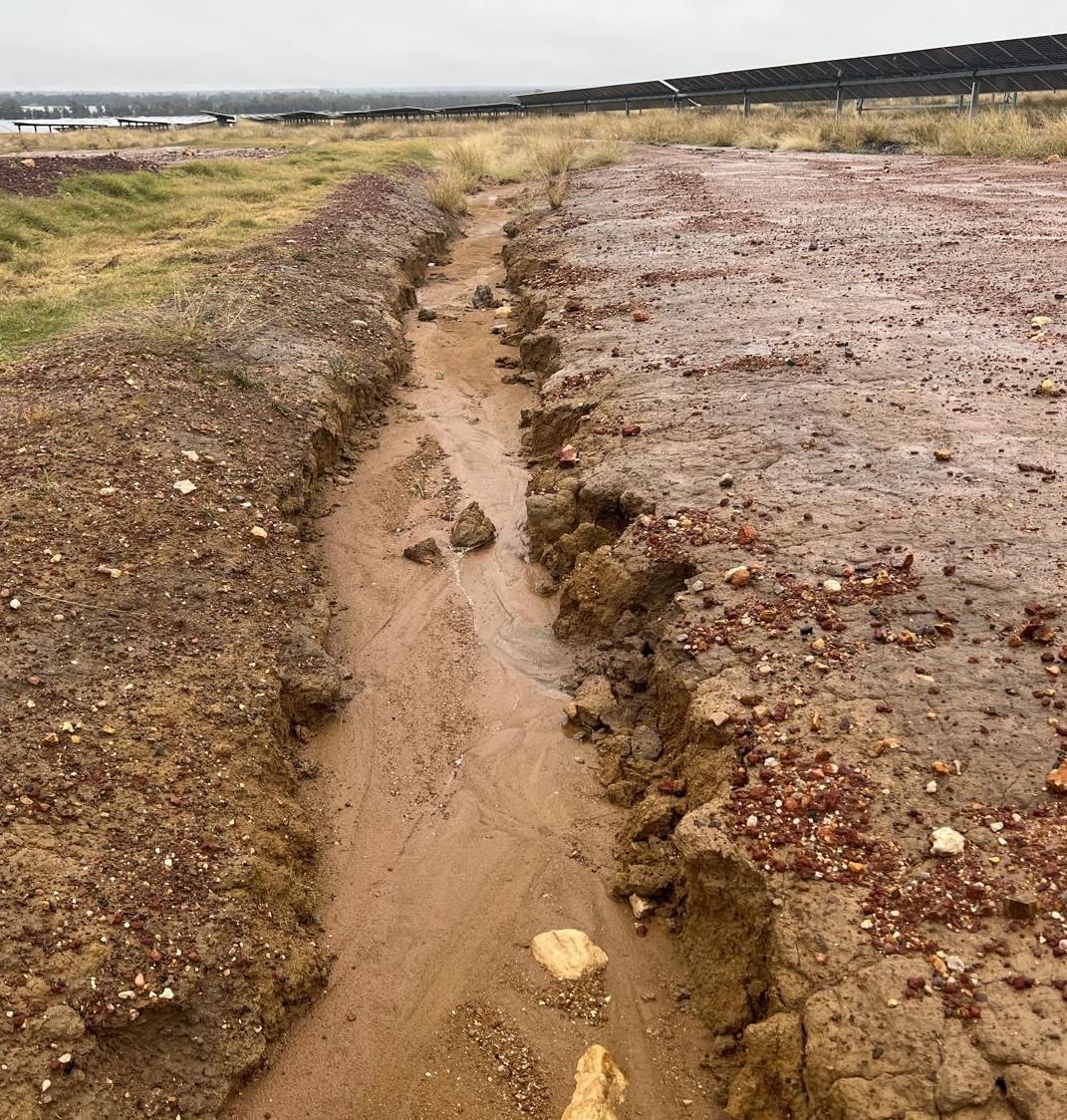
In Queensland, it's no secret that the renewables industry is booming. However, consistently, particularly in the south of the state, these projects are quickly encountering an unexpected challenge - dispersive soils. While those in the erosion and sediment control field could reasonably foresee this based just on the geographic location or through a brief site visit only, consistently renewables projects are not aware of this aspect until well into construction, when unexpected erosion issues start to emerge. It may be surprising that these very significant projects, with budgets of hundreds of millions of dollars, can overlook an aspect that is likely to cause considerable challenges if management is not planned and budgeted. Failure to identify dispersive soils in project scoping and planning can result in development of inappropriate erosion and sediment control plans, unsuitable rehabilitation plans, failing rehabilitation, and lengthy maintenance periods of erosion and sediment controls until groundcover is achieved (including desilting, reshaping, restabilising). Drains fail due to erosion, releasing sediment which settles downgradient, reducing drain capacity, resulting in drain overtopping and sediment deposition onto roads or hardstands (reducing trafficability) or releasing sediment into waterways. Erosion and poor stormwater management from failed drainage can mean water is not managed as per design and begins to erode in and around infrastructure, including roads, hardstands, solar panel piles, and waterway culvert crossings, resulting in expensive repairs of often difficult to access areas (particularly in solar construction due to tracking infrastructure). Some projects believe they will solve their erosion issues with hard reinforcing, like rock placement (riprap) or shotcrete or concrete, and are consequently shocked when these expensive repairs are promptly undermined. These impacts can result in landholder and broader community complaints, environmental consequences, compliance challenges, and costly rework. During project planning, there are multiple avenues to identify this challenge. From an initial desktop perspective, publicly available soil mapping with attached descriptions could be reviewed, which will indicate dispersiveness. Even at the highest level of state-wide soil classification, the considerable portion of the state mapped as sodosols should be an indication of potential dispersiveness, named due to high concentrations of exchangeable sodium, driving sodicity, which often results in dispersion. Assuming these aspects are overlooked, the early onsite inspections allow for an opportunity to visually observe indications of dispersive soil, often presenting as gully erosion along pre-existing roadsides and along farm tracks, or as gully or tunnel erosion adjacent to waterways, which contain the classic 'chocolate milk' water. These inspections are generally undertaken by ecologists and geotechnical engineers, and rarely, if ever, by erosion and sediment control specialists. Identifying this potential constraint is not in their purview, or skillset. Geotechnical investigations always include Emerson Testing, which is a measure of the dispersiveness of a soil, however this almost always is restricted to the depth of the base of foundations, well below the topsoils or subsoils likely to be disturbed, exposed, and requiring final stabilisation. However, even when shallower soils indicate dispersiveness, such as being Emerson Class 1 or 2, this is often only considered in foundation design, and is not considered in drainage design, erosion and sediment control or rehabilitation scoping, planning and budgeting. Due to these common oversights, it is important to turn our attention to developing improved recommendations for renewables developers to identify dispersive soils, and communication of these. Using a common ~40 turbine wind farm as an example, which is generally linear infrastructure (consisting of significant lengths of roads connecting turbines), and taking guidance from the IECA White Books, Chapter 3 Site Planning, Table 3.2, the required number of sample sites would be in excess of 930. Using an estimate of 1 sample location per 30 mins, it is unlikely that a wind developer will be interested in 232 days of soil sampling prior to/during project scoping. While the gold standard would likely consist of a full-scale soil survey including sampling for all relevant characteristics (including dispersiveness) and development of associated soil mapping, with final micrositing of project infrastructure (particularly wind turbines) having consideration of soil characteristics, it is unrealistic to move immediately from the current process to this. In order to identify the existence of dispersive soils, a well-designed reduced soil sampling program and analysis suite is possible, which will fast track the process and reduce costs. In our experience, Emerson Aggregate Testing has not proven to be a reliable indicator of dispersion, if other soil characteristics are disregarded. If targeting dispersion only, a more suitable suite is one that includes, at least, exchangeable basic cations (Calcium, Magnesium, Potassium, Sodium), Cation Exchange Capacity and Particle Size Distribution, in addition to Emerson Aggregate Testing (EAT). In our experience, soils can exhibit severe dispersion in the field, and have exchangeable cation aspects which would indicate a high likelihood of dispersiveness (such as sodic or magnesic soils), but have moderate to low dispersiveness based on Emerson testing. The reason for this is currently unknown comprehensively, though some theories are held and are under investigation. Furthermore, sands and gravels are unsuitable for Emerson testing, and failure to undertake Particle Size Distribution (or field assessment) to identify these may result in EAT scores that indicate negligible dispersiveness, yet the soil may lack soil cohesiveness, which tend to erode regardless of dispersiveness. Identification of dispersive soils is critical in the planning and design stage of renewables projects to prevent budget blowout. Topsoils and shallow subsoils should be included in sampling regimes as part of project scoping, or at least, early works. A reduced sampling density and analysis scope is suggested to be sufficient for this purpose, and should be undertaken by all renewables developers. Last updated 27 August 2024. This information is general in nature, may not be current, and may not be applicable to your specific circumstances. It should not be used as a substitute for site-specific professional advice.
By Lisel Dingley August 13, 2024
What is a weed?
By Lisel Dingley January 16, 2024
Common mistakes with AS 1940 Compliance
By Dynamic Environmental Services August 18, 2022
Waste management facilities that accept regulated wastes require robust environmental monitoring and management systems to ensure compliance, protect environmental values and identify potential issues before they become significant risks. Dynamic Environmental Services supported the ongoing environmental management of a regulated waste facility accepting a range of waste streams, including PFAS-impacted materials and liquid wastes. The project required the development of practical and defensible environmental monitoring and management systems capable of supporting both operational decision-making and regulatory compliance. Our role involved reviewing historical monitoring data, assessing site-specific risks and developing a tailored monitoring and management framework aligned with the site's operations, Environmental Authority requirements and contaminants of concern. Our services included: Review of historical environmental monitoring data Assessment of Environmental Authority requirements Development of Environmental Monitoring and Management Plans Review and optimisation of monitoring programs Identification of site-specific contaminants of concern Groundwater monitoring and sampling Surface water and receiving environment monitoring Landfill gas monitoring Leachate and received wastewater monitoring Quarterly monitoring and reporting Trend analysis and interpretation of monitoring results Environmental compliance advice and support Development of practical management recommendations A key objective of the project was ensuring that monitoring activities generated meaningful information rather than simply collecting data to satisfy compliance requirements. Monitoring locations, analytes and reporting processes were constantly reviewed to improve the site's ability to identify emerging issues, understand environmental trends and support proactive environmental management. The project also required consideration of long-term environmental liabilities, operational requirements, regulatory expectations and financial assurance obligations. By integrating monitoring, management planning and data interpretation, we helped provide a clearer understanding of environmental risks and a more effective framework for ongoing site management. Outcomes Improved environmental monitoring and management framework Monitoring programs aligned with site-specific risks and contaminants of concern Development and maintenance of a comprehensive environmental monitoring database Improved ability to identify and respond to emerging environmental trends Ongoing compliance with Environmental Authority requirements  Practical environmental management recommendations to support ongoing operations